
A Deep Study of History1700–1730, 1800–1830, 1900–1930, and 2000–2030 and What the Patterns Reveal About the Century Now Being Written
“There are decades where nothing happens; and there are weeks where decades happen.” – Vladimir Lenin
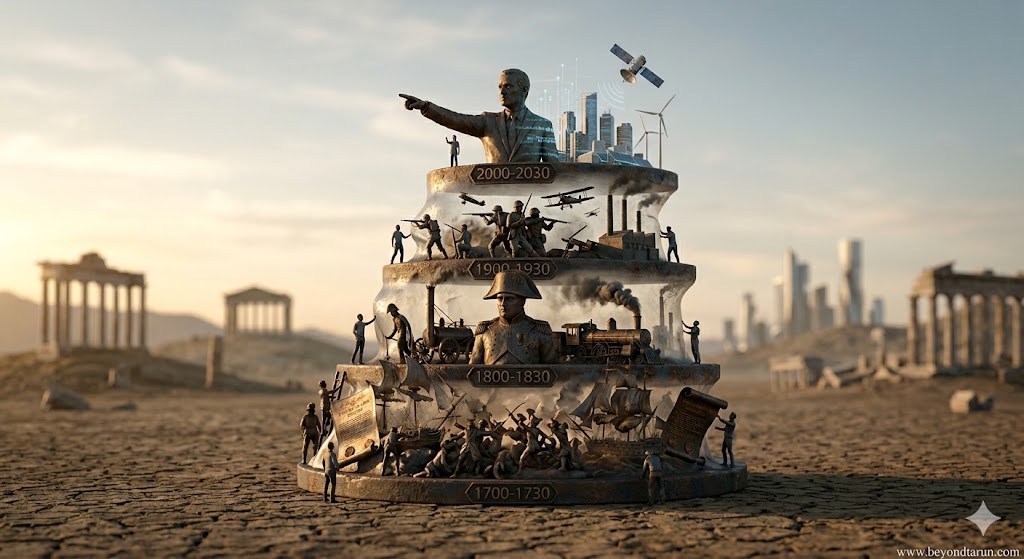
History does not move at a steady pace. It accelerates, compresses, and crystallizes and then the crystallized form hardens into the bedrock upon which the next generation must build, fight, and live. If you study the record carefully, across centuries and across continents, a striking structural pattern begins to emerge: the first thirty years of each century do not merely describe what that century will become. They determine it.
This is not a mystical claim. It is an empirical one. The wars settled, the technologies introduced, the institutions built, and the grievances planted in the opening three decades of any given hundred-year stretch tend to compound, echo, and detonate throughout the remaining seventy years sometimes in recognizable form, sometimes in terrifying disguise. The peace treaties of the early decades become the fault lines of mid-century wars. The inventions of the early decades become the civilizational infrastructure that generations cannot imagine living without. The suppressed movements of the early decades return, amplified and radicalized, decades later.
This essay traces that pattern across four periods: 1700–1730, 1800–1830, 1900–1930, and finally the period we are living through now 2000 to 2030. It draws on historical record, credible scholarship, and cross-century pattern recognition to argue a single thesis: we are presently inside the mold that will cast this entire century, and understanding what is being poured into that mold right now is among the most important intellectual exercises available to us.
1. THE EIGHTEENTH CENTURY’S OPENING MOLD: 1700–1730
A Continent at War with Itself
The eighteenth century did not open gently. Europe in 1700 was a continent of anxious sovereigns, contested thrones, and imperial rivalries stretched thin across multiple continents simultaneously. The death of Charles II of Spain childless, the last of the Habsburg Spanish line in 1700 detonated a crisis that had been anticipated with dread for decades. By naming Philip of Anjou, grandson of France’s Louis XIV, as his successor, Charles handed his vast empire spanning Spain, the Spanish Netherlands, Naples, Milan, and the colonies of Latin America and Asia to the very power that the rest of Europe most feared.
The resulting War of the Spanish Succession (1701–1714) was, by the standards of its time, a total war. It engulfed most of continental Europe, spilled into North America as Queen Anne’s War, drew in Britain, Austria, the Dutch Republic, and Portugal against France and Spain, and lasted thirteen years. The key battles Blenheim (1704), Ramillies (1706), Oudenarde (1708) became landmarks of European military history. The Treaties of Utrecht, Rastatt, and Baden (1713–1714) that ended it were arguably the most consequential diplomatic documents produced between the Peace of Westphalia (1648) and the Congress of Vienna (1815).
What those treaties established was not simply a resolution to a dynastic dispute. They established the rules of the game for European power for the next century. The Treaty of Utrecht marked the rise of Great Britain as the dominant maritime and commercial power while ending the hegemonic ambitions of France. It secured the balance of power and helped regulate the relations between the major European powers for the coming century. British foreign policy was henceforth organized around one overriding principle preserving a balance of power in Europe and that principle remained consistent from the 16th through the 20th centuries. Utrecht was where it was formally encoded.
Every major European conflict of the 18th century the War of Austrian Succession, the Seven Years’ War, the Revolutionary Wars that closed the century was fought within the framework Utrecht established. The players changed-the rules did not.
Simultaneously, in the east, the Great Northern War (1700–1721) between Russia and Sweden was rebalancing northern Europe just as decisively. When it ended, Sweden’s era of dominance was over, and Russia rebuilt, westward-gazing, powered by the reforming fury of Peter the Great who was literally constructing a new capital (St. Petersburg) on swampland as a statement of intent emerged as a great power. Prussia was formally declared a kingdom in 1701. The Kingdom of Great Britain was formalized by the Act of Union in 1707. The map of power in Europe was being redrawn in this thirty-year window with consequences that would persist for two centuries.
In Asia, the death of Mughal Emperor Aurangzeb in 1707 set off a fragmentation of the most powerful empire on the subcontinent, as the Maratha Empire began slowly replacing it. This collapse of central authority in India a direct product of these opening decades is what made the subcontinent vulnerable to British commercial penetration. The East India Company’s eventual conquest of India was made possible not in the 1750s at Plassey, but in the 1700s when the Mughal center fell. History’s most consequential colonial takeover was seeded in this opening window.
The Enlightenment’s Legal Infrastructure
Less dramatic but equally consequential was an institutional innovation that occurred in 1710: the Statute of Anne, the world’s first copyright legislation, came into effect in Britain. In one document, intellectual output was transformed from a royal privilege into individual property. The commercial book trade exploded. Literacy spread. The pamphlet culture that fueled the American and French Revolutions was made possible by this legal infrastructure. The Enlightenment that extraordinary flowering of rational inquiry, political philosophy, and scientific method that would produce the Declaration of Independence, the Critique of Pure Reason, and the Rights of Man required a distribution mechanism. The Statute of Anne built that mechanism.
Add to this the mercury thermometer (1714), the first daily newspapers in England (1702), and the Fahrenheit temperature scale (1724), and you begin to see an opening decade that was simultaneously creating the political, institutional, and scientific infrastructure for everything the 18th century became. The wars settled who would rule. The legal innovations settled how knowledge would flow. The scientific instruments settled how nature would be measured. All three dimensions of the century’s identity were determined before 1730.
2. THE NINETEENTH CENTURY’S OPENING MOLD: 1800–1830
Napoleon and the Permanent Disruption of the Old Order
If the 18th century’s opening mold was cast in the crucible of dynastic war and commercial competition, the 19th century’s was forged by a single man and the ideas he carried on his bayonets. Napoleon Bonaparte did not simply conquer territory. He dissolved the accumulated political architecture of centuries the Holy Roman Empire, the feudal aristocracies of central Europe, the divine-right monarchies of the ancient regime and replaced it with something new and combustible: the nation-state organized around popular sovereignty and the rule of law.
The Napoleonic Wars (1803–1815) reshaped Europe’s political boundaries and influenced nationalist movements in ways that reverberated for the entire century that followed. As Napoleon’s armies conquered and occupied various territories, they introduced reforms that promoted national unity and identity the Napoleonic Code, conscript armies, administrative centralization while simultaneously provoking nationalist resistance in the countries they occupied. The paradox was total: Napoleon spread the virus of nationalism even as his empire depended on suppressing it.
Napoleon’s kingdoms consolidated scattered territories in Germany and Italy, and the welter of divided states was never restored. These developments, but also resentment at Napoleonic rule, sparked growing nationalism in Germany, Italy, Spain, and Poland. Prussia and Russia introduced important political reforms as a means of strengthening the state to resist the Napoleonic war machine. The seeds of German and Italian unification accomplished in 1871 were planted in these early decades when Napoleon scrambled and reshuffled the political geography of the continent.
His defeat at Waterloo in 1815 brought the Congress of Vienna, which attempted to restore the old dynastic order. It succeeded only partially and temporarily. The Congress of Vienna largely ignored emerging nationalist sentiments and instead prioritized the restoration of traditional monarchies and the preservation of a balance of power. This disregard for national identity helped fuel the revolutionary waves of 1830 and, more dramatically, of 1848 a series of uprisings often referred to as the “Spring of Nations.” History had been handed a blueprint for the rest of the century, and the blueprint was legible: when you suppress national self-determination, it accumulates pressure and eventually explodes.
Yet the Congress also produced something genuinely constructive: the Concert of Europe. The five powers : Austria, Britain, France, Prussia, and Russia, ushered in a period of relative peace in the international political system. These great powers fought no major wars against each other until the Crimean War in 1854. For nearly forty years, a multilateral management system kept the peace in Europe. This, too, was one of the 19th century’s defining features, and it was negotiated and established in these opening decades.
A Wave of Independence That Remapped the World
The period from 1810 to 1830 produced the most concentrated explosion of national independence movements in recorded history up to that point. Mexico, Peru, Brazil, Colombia, Argentina, Chile, Venezuela, Bolivia, Ecuador, the entire architecture of independent Latin America was assembled in roughly twenty years. Nearly all of it was a direct consequence of the Napoleonic Wars, which had destabilized the Spanish and Portuguese crowns and removed the imperial authority that had kept colonial ambitions in check.
Greece became the first country to break away from the Ottoman Empire in this period, after the Greek War of Independence, a struggle that drew in Britain, France, and Russia and established the precedent of great powers intervening in favor of national self-determination. The Monroe Doctrine (1823), declared by U.S. President James Monroe, codified the Western Hemisphere as off-limits to further European colonization. The entire geopolitical architecture of the Americas for the next two centuries was sketched in this opening window.
The Steam Engine and the Industrial Irreversibility
The Stockton and Darlington Railway opened in England in 1825, the world’s first public railway to use steam locomotives. By 1830, the Liverpool and Manchester Railway was operating as the world’s first intercity passenger line. These were not merely transportation innovations. They were the visible tip of a transformation that would remake the entire material basis of human civilization.
The industrial revolution already underway in British textile mills suddenly had its accelerant. Railways meant that raw materials could move from mines to factories to markets at previously impossible speeds. They meant that armies could deploy with unprecedented efficiency, that food could reach cities that could not otherwise feed themselves, that the entire logic of where people lived and how they worked was about to change. The urbanization, mass immigration, labor movements, and colonial extraction that defined the 19th century’s second half were all downstream of this opening technological bet.
3. THE TWENTIETH CENTURY’S OPENING MOLD: 1900–1930
A Deceptive Peace, Then the Great Catastrophe
The 20th century opened in a kind of false serenity. The period from 1900 to 1913 is, by geopolitical risk indices, one of the three safest periods of the 20th and 21st centuries combined. The great powers were at nominal peace. Science was producing extraordinary breakthroughs Max Planck announced quantum theory in December 1900 Marconi transmitted the first transatlantic radio signal in 1901. The world was globalizing, trade was expanding, and a kind of belle époque optimism pervaded European capitals.
Underneath it, the foundations were cracking.
The causes of World War I included the rise of the German Empire and decline of the Ottoman Empire, which disturbed the long-standing balance of power in Europe, the exacerbation of imperial rivalries, and an arms race between the great powers. The assassination of Archduke Franz Ferdinand on June 28, 1914 by a Serbian nationalist in Sarajevo was not a cause. It was a trigger. The explosive had been assembled over decades. Austria-Hungary, with German encouragement, declared war on Serbia. Russia’s support of Serbia brought France into the conflict. Germany declared war on Russia on August 1 and France on August 3. Germany’s violation of Belgian neutrality brought Britain in on August 4. Within six weeks of a single assassination, the entire developed world was at war.
What followed was one of the deadliest conflicts in history, resulting in an estimated 15 to 22 million military and civilian casualties. Four empires the Ottoman, Austro-Hungarian, Russian, and German were destroyed or fundamentally transformed. The movement of large numbers of people was a major factor in the deadly Spanish flu pandemic of 1918, which killed an estimated 20 to 50 million additional people. The world of 1920 was barely recognizable from the world of 1910.
The Peace That Planted the Next War
The Treaty of Versailles, signed on June 28, 1919 exactly five years after the Sarajevo assassination was designed to guarantee lasting peace. It accomplished the opposite. By placing the burden of war guilt entirely on Germany, imposing harsh reparations payments, creating an increasingly unstable collection of smaller nations in Europe, and humiliating the German population without crushing the German state, the treaty failed to resolve the underlying issues that caused war to break out in 1914, and helped pave the way for another massive global conflict twenty years later.
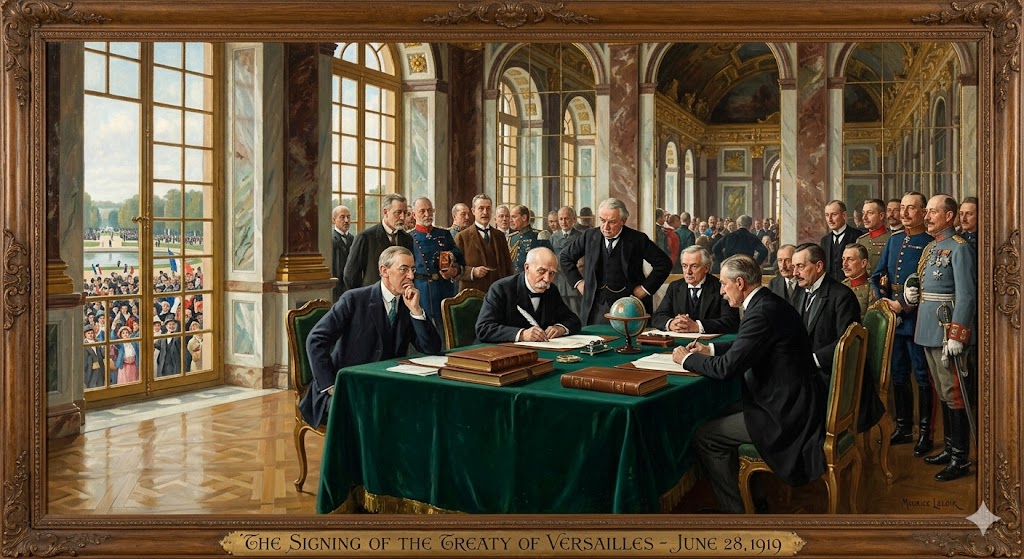
The economic consequences were immediate. Germany could not make its reparations payments. By 1923, hyperinflation had rendered German currency virtually worthless. The American Dawes Plan provided temporary relief, but when the Great Depression hit in 1929, the entire edifice collapsed. Between 1929 and 1932, worldwide GDP fell by an estimated 15%. In the United States, industrial production fell by nearly 47 percent, and unemployment reached more than 20 percent. International trade fell by more than 50%. The economic distress and seething resentment of the Versailles treaty within Germany helped fuel the rise of Adolf Hitler and his Nazi Party.
The chain is exact and direct: WWI (1914) → Versailles humiliation (1919) → German hyperinflation (1923) → Great Depression (1929) → Hitler’s rise (1933) → WWII (1939). Every link in that chain was forged in this thirty-year opening window. The second war, for all its independence as an event, was in a profound sense the unfinished business of the first. The century’s most catastrophic thirty years 1914 to 1945 were a single continuous crisis whose first act was written between 1900 and 1930.
The Russian Revolution and the Century’s Ideological Framework
The Bolshevik Revolution of 1917 installed a government in Russia that would endure for seventy-four years and define the ideological contest of the entire century. Communism as a global force generating the Cold War, the Korean War, the Vietnam War, the Cuban Missile Crisis, the proxy conflicts across Africa, Asia, and Latin America, and the nuclear arms race that kept humanity one miscalculation from extinction was born in this thirty-year window.
The Russian Revolution also planted the seeds of decolonization that would be harvested decades later. WWI stirred rising nationalist sentiment across colonial territories: colonial soldiers returned home with a broader worldview, questioning their subordinate status. Declarations of independence in places like Ireland (1916) and Korea (1919) were early signs of a resistance that would grow through mid-century into the great wave of decolonization that remapped Asia and Africa between 1945 and 1975. The conceptual detonator the idea that subordinated peoples were entitled to self-determination was ignited in this opening window, even though the explosion came later.
The Depression, finally, forced governments everywhere to permanently assume responsibility for the economic welfare of their citizens. The modern welfare state, bank regulation, Keynesian economic management, and the concept of government as guarantor of economic stability all of these were born in direct response to the crisis of the late 1920s and 1930s. They remain the architecture of governance today.
4. THE TWENTY-FIRST CENTURY’S OPENING MOLD: 2000–2030
The Decade of Shocks: A Unipolar World Begins to Fracture
The 21st century opened, like the 20th, in a kind of deceptive stability. The Cold War was over. The United States stood as the world’s sole superpower economically dominant, militarily unchallengeable, culturally pervasive. The 1990s had been years of globalization, democratization, and techno-optimism. The internet was new. The future seemed open.
Then September 11, 2001 happened.
The attacks did not merely kill nearly three thousand people and destroy the World Trade Center. They permanently rewired the relationship between citizens, states, surveillance, and security across the entire developed world. The “War on Terror” became an open-ended civilizational project the wars in Afghanistan and Iraq alone lasted twenty years and reshaped the politics of the Middle East in ways still unresolved. The Patriot Act, TSA, mass surveillance programs, drone warfare, and the normalization of permanent military deployments in distant lands all emerged from this single event’s aftermath. The shock of 9/11 is to the 21st century what the shock of Sarajevo was to the 20th: a trigger event that revealed deep structural pressures that had been building for years.
The 2008 financial crisis completed the decade’s transformation. The Great Recession triggered by the collapse of the U.S. subprime mortgage market and the cascading failure of financial institutions that had become too interconnected to allow failure produced the worst global economic contraction since the 1930s. The damage was not merely financial. It permanently eroded trust in institutions, in expertise, in the rules-based liberal order that had governed the post-Cold War world. The political populism that would erupt in the 2010s and 2020s Brexit, Trump, the rise of nationalist parties across Europe and Asia was seeded in the rubble of 2008.
The Decade of Fracture: Power Shifts and the World Reorganizes
The 2010s were characterized by a series of disruptions whose full significance we are still processing. The Arab Spring (2011) swept across the Islamic world, toppling governments in Tunisia, Egypt, and Libya, igniting civil wars in Syria and Yemen, and briefly suggesting that the democratic aspirations of the 20th century’s decolonization movements were finally being realized. Instead, most revolutions failed, producing either military restoration, civil war, or jihadist exploitation of the resulting vacuum. The Arab Spring was the century’s version of the 1848 “Spring of Nations” a revolutionary wave that failed in its immediate aims but planted ideological seeds that will continue to grow.
Russia’s annexation of Crimea in 2014 was, in retrospect, the moment the post-Cold War order definitively ended. A major European power had annexed the territory of a neighboring sovereign state for the first time since 1945. The rules-based international order upheld since 1945 by the proposition that borders could not be changed by force had been violated. The West’s response, limited sanctions and diplomatic condemnation, signaled that the enforcement capacity of that order was weaker than it appeared. Russia drew the correct operational conclusion and expanded the invasion in 2022.
China’s rise, meanwhile, accelerated throughout the decade. In 2015, the Chinese government announced the “Made in China 2025” initiative with the goal of upgrading its manufacturing industry, reducing its reliance on foreign technology, and dominating the strategic industries of the 21st century: artificial intelligence, quantum computing, biotechnology, advanced manufacturing. The United States responded with tariffs in 2018. The great power rivalry of the century was now in the open.
Politically, the 2010s were the hottest decade in recorded history. The Paris Agreement of 2015 was adopted a landmark in international climate cooperation that nonetheless fell far short of the commitments needed to prevent catastrophic warming. Climate change was transitioning from a scientific prediction to a lived experience: record heat waves, unprecedented wildfires, intensifying hurricanes, accelerating ice loss. The physical environment was becoming a political actor.
The Decade of Convergence: Everything Arrives at Once
The 2020s have compressed an extraordinary number of historical forces into a single decade. The COVID-19 pandemic the worst pandemic since the 1918 Spanish flu killed millions, triggered the deepest global recession since the Great Depression, forced governments to intervene in economies at wartime scale, and permanently accelerated the digitalization of work, education, commerce, and social life. The pandemic did not create the major trends of the decade, it turbocharged them. Growing inequality, eroding trust in democratic institutions, obsolete global governance architecture, and accelerating technological disruption all of these were underway before 2020. The pandemic made them impossible to ignore.
Russia’s full-scale invasion of Ukraine in 2022 completed the dismantling of the post-1989 European security order and reminded a generation that had never experienced major interstate war in Europe that the machinery of mass destruction remained operational, that territorial conquest remained a live policy option, and that energy dependency was a strategic vulnerability. The economic consequences: inflation, food insecurity, energy price shocks radiated across the globe, demonstrating once more that in an interconnected world, a war in eastern Europe raises food prices in sub-Saharan Africa.
And then, in the middle of this already compressed decade, artificial intelligence crossed a threshold that may prove to be the most consequential technological event in human history since the Industrial Revolution. The release of large-scale generative AI systems in the early 2020s produced something unprecedented: a technology that reached hundreds of millions of users within one to two years of deployment the fastest technology diffusion in history and that did not merely automate physical or computational tasks but began automating cognition itself. The implications are not yet fully visible, but their direction is clear. AI is not a tool in the way a steam engine was a tool. It is a new cognitive layer being added to civilization one that will reshape labor, governance, warfare, science, education, and the nature of human agency itself.
5. THE PATTERN LAID BARE: WHAT HISTORY INSISTS WE SEE
Having traced four centuries through their opening three decades, the structural patterns are unmistakable. Let us name them precisely.
Pattern One: Opening Wars Determine the Century’s Power Architecture
Every century’s first major conflict established the rules by which power would be organized, contested, and occasionally overturned for the rest of that century. The War of Spanish Succession (1701–1714) established British maritime dominance and the balance-of-power principle that would govern European diplomacy for nearly a century. The Napoleonic Wars (1803–1815) destroyed the old dynastic order and installed nationalism as the organizing principle of political legitimacy a principle that then drove every major conflict from Italian and German unification through to both World Wars. The Great War (1914–1918) and its catastrophically botched peace created the grievances, ideologies, and power vacuums that produced the century’s worst catastrophes.
The 21st century’s opening conflicts: 9/11 and the War on Terror, the 2003 Iraq invasion, the 2008 financial crisis as an economic war of sorts, Ukraine, Gaza are collectively doing the same thing. They are marking the end of one world order and the contested emergence of another. The American unipolar era is over. A multipolar world principally structured around the US-China rivalry, with Russia as a dangerous spoiler and the Global South increasingly asserting agency is the new baseline condition. The question that history insists we ask is: what treaty, what settlement, what institutional architecture will stabilize this new reality? And the historical pattern warns: if no stable settlement emerges if the major powers cannot negotiate new rules of the game the century’s mid-point will likely bring a systemic conflict of a severity not seen since the 1940s.
Pattern Two: Opening Technologies Become the Century’s Civilizational Infrastructure
No century in our survey developed technologies in its opening decades that remained mere curiosities. Every significant invention compounded. The Statute of Anne (1710) enabled the Enlightenment’s intellectual economy. The steam railway (1825) powered the Industrial Revolution’s second phase. Quantum physics and radio (1900–1920s) produced nuclear weapons, computing, and the information age. In each case, the technology introduced in the opening decades became so deeply embedded in civilization’s operating logic that subsequent generations could not imagine existence without it.
Artificial intelligence is this century’s compounding technology and it is arriving faster and penetrating deeper than any previous example. The adoption speed is unprecedented. Within one to two years of release, generative AI systems reached hundreds of millions of users, with billions engaging indirectly through integrations into search engines, office software, and consumer applications. This makes AI the fastest-diffusing technology in human history. And unlike the steam engine (which amplified physical labor) or the computer (which amplified information storage and retrieval), AI amplifies cognition itself the one resource that all previous technological revolutions assumed would remain distinctively human. The implications of that shift are not incremental. They are categorical.
What does the pattern predict? That AI will be to the 21st century what steam was to the 19th: not just an industry, but the organizing principle of an entire civilization. The nations that control the most capable AI systems will hold the century’s equivalent of the naval supremacy that Britain won at Utrecht and consolidated through Trafalgar. The societies that successfully manage AI’s disruption to labor and governance will prosper those that fail will face social fractures of the kind that industrialization produced in the 19th century Chartism, labor wars, political extremism before adequate regulatory and institutional frameworks were developed.
Pattern Three: Suppressed Movements Fail in the Opening Decades and Return Transformed
This is perhaps the most consistent and underappreciated pattern in the record. The Ashanti Empire rose in 1701 but African independence took two and a half centuries. The Latin American revolutions of the 1810s succeeded formally but took generations to produce stable democratic governance. The 1848 revolutions failed almost universally but planted the ideological seeds of every major political transformation of the 19th century’s second half. WWI’s colonial soldiers returned home questioning their subordinate status, but their nations gained independence only in the 1940s–1960s. The decolonization wave was a lagged consequence of seeds planted in the century’s opening decades.
The 21st century’s equivalents are already visible. The Arab Spring failed but the political consciousness it generated did not disappear. The youth climate movement that emerged around 2018 has not yet forced systemic change but it represents a generation for whom climate disruption is not a future threat but a present reality, and that generation will be in power by mid-century. The Global South’s demand for a reformed international financial architecture relief from colonial-era debt structures, equitable representation in the IMF and World Bank, climate financing from wealthy nations that created the problem has not yet been met, but it is louder and better-organized than at any previous point.
The historical pattern is clear: these movements do not die when they fail. They go underground, they accumulate grievances, they develop better leadership and sharper analysis, and they return usually in the 2030s–2060s equivalent, sometimes in forms their original participants would barely recognize. The question for the rest of this century is not whether these forces will reassert themselves but in what form and with what level of violence.
Pattern Four: Crises Force the State to Permanently Expand Its Responsibilities
The Statute of Anne permanently embedded intellectual property rights in the legal architecture of civilization. The Napoleonic Code restructured civil law across Europe for centuries. The Great Depression produced the welfare state, deposit insurance, central bank intervention, and Keynesian economics institutions still functioning today. In each case, a crisis of the opening decades permanently expanded what government was expected to do and what citizens were entitled to expect.
The 21st century has already produced two such crisis-driven expansions. The 2008 financial crisis produced the Dodd-Frank regulatory framework and a new consensus that systemic financial institutions required public oversight. The COVID-19 pandemic produced direct government payments to citizens at scale, state-coordinated vaccine development, and the normalization of government intervention in labor markets a peacetime expansion of state responsibility without modern precedent. These are not temporary measures. They are precedents. And they will be drawn upon again when the next crisis arrives.
The next crisis is, in fact, already underway. AI-driven labor displacement credibly projected to affect between 40 and 50 percent of existing job categories over the coming decades will create political pressure for government response that will make the New Deal look modest. The combination of pandemic precedent, climate adaptation costs, and AI disruption virtually guarantees that the state will be significantly larger, more interventionist, and more economically active by 2050 than it is today. The political battles of the next two decades universal basic income, AI taxation, carbon pricing, digital rights, data sovereignty are the 21st century’s equivalent of the 1930s debates over Social Security and labor law.
6. THE UNPRECEDENTED DIMENSION: CLIMATE AS THE CENTURY’S ORIGINATING CATASTROPHE
Every previous century in this analysis had one originating catastrophe that structured the entire downstream history: the succession wars for the 18th century, the Napoleonic upheaval for the 19th, WWI and the Depression for the 20th. But all of those catastrophes were, in a crucial sense, episodic. Wars end. Depressions bottom out. Revolutions are suppressed or succeed. And then societies rebuild.
The 21st century’s originating catastrophe is different in kind, not just degree. Climate change does not end. It accumulates. And beyond certain physical thresholds the so-called tipping points it becomes self-reinforcing and irreversible in any timeframe meaningful to human civilization.
The science is now unambiguous. Already at 1.4°C of global warming, warm-water coral reefs are crossing their thermal tipping point and experiencing unprecedented dieback, impairing the livelihoods of hundreds of millions who depend on them. Parts of the polar ice sheets may also have crossed tipping points that would eventually commit the world to several metres of irreversible sea-level rise affecting hundreds of millions more. The world is poised to overshoot the goal of limiting average global warming to 1.5°C, as for the first time a three-year period ending in 2025 breached the threshold.
These are not predictions. They are measurements. The physical consequences more extreme heat waves, intensifying droughts and wildfires, disruption to agricultural systems that feed billions, coastal flooding of major population centers, mass displacement of people from newly uninhabitable regions will compound throughout the century in ways that interact with and amplify every other crisis: economic instability, geopolitical conflict, technological disruption, democratic erosion. Climate change is not one problem among many. It is the multiplier of all other problems.
This is where the historical pattern partially breaks down or rather, where the 21st century reveals itself to be genuinely unprecedented. Previous originating catastrophes were resolvable. The wars ended. The depressions bottomed out. The political settlements held, at least for a time. Climate change, beyond the tipping points we are now approaching, does not resolve. It escalates. The decisions made in this opening window whether we build sufficient renewable energy infrastructure, whether we price carbon adequately, whether we fund adaptation at the scale required will not simply shape the 21st century. They will shape the geological era that follows it.
History, for the first time, may be making a decision that cannot be unmade.
7. THE MOLD WE ARE INSIDE: 2025 AND THE VIEW FROM THE HINGE
We are, at this writing, roughly twenty-five years into the 21st century’s opening mold. Several things have already hardened. Several things are still liquid.
What has already hardened:
The American unipolar order is over. This is not a prediction it is a description of what has already happened. The rise of China, Russia’s revisionist aggression, the institutional paralysis of the UN Security Council, the fracturing of global trade into competing blocs, and the erosion of international norms that held since 1945 these are accomplished facts. The new multipolar world is not yet fully formed, but the old world is definitively gone. Whatever peace settlement or power equilibrium emerges in the coming decades will be built on this foundation, not the one that existed in 1999.
AI is now irreversibly embedded in civilization’s infrastructure. The technology is deployed, the investment is committed, the institutional adoption is underway, and the competitive dynamics between nations ensure that no major power will unilaterally constrain its own AI development. The question is not whether AI will transform civilization but how that transformation will be navigated whether it will produce the “compressed century” of accelerated scientific progress, or whether it will produce the social fractures and governance failures that accompanied the Industrial Revolution before adequate frameworks were developed.
What is still liquid:
The US-China rivalry has not yet found its equilibrium. Whether it produces a new Cold War that structures geopolitics for a generation, a negotiated multipolar framework analogous to the Concert of Europe, or a hot war over Taiwan that reorders everything this remains undetermined. The historical lesson from previous centuries is sobering: when major power transitions go unmanaged, they tend to resolve through catastrophic conflict rather than peaceful negotiation.
The climate trajectory remains just barely, alterable. The window for preventing the worst outcomes is narrowing rapidly, but it has not yet closed. The decisions made at COP30 and in the domestic energy policies of major emitters in the late 2020s and early 2030s will determine which kind of 21st century the remaining seventy years inhabit.
The institutional architecture of the post-crisis state is still being designed. Whether universal basic income, AI regulation, carbon pricing, and digital rights are built into the century’s governance framework in the coming decade will determine what kind of social contract humanity operates under for generations.
8. THE PATTERN’S FINAL LESSON: THE IMPORTANCE OF THIS MOMENT
The pattern traced across three centuries delivers a single, urgent message: the decisions made in the opening decades of a century are not merely important. They are constitutive. They set the rules, establish the precedents, deploy the technologies, plant the grievances, and design the institutions that the rest of the century cannot escape. This is why the historian’s perspective on the present moment is not a luxury but a necessity.
We have seen how Utrecht (1713) locked in a century of British commercial dominance and European balance-of-power management. We have seen how Vienna (1815) created forty years of peace while planting the nationalist seeds of the century’s most transformative conflicts. We have seen how Versailles (1919) a peace treaty designed to prevent another war guaranteed one. The lesson is not that great settlements are impossible. It is that great settlements require the rare combination of wisdom, humility, and political courage to look beyond immediate advantage toward long-term stability.
The equivalent question for our moment is: what are we doing, right now, in these first three decades of the 21st century, that will look to historians of the 22nd century the way Versailles looks to us today? What grievances are we planting that will detonate? What technologies are we releasing without adequate governance frameworks? What physical thresholds are we crossing that cannot be uncrossed?
The historical pattern does not offer comfort. Previous opening decades were not navigated wisely. The leaders of 1914 did not realize, as they mobilized their armies, that they were signing the death warrant of the world they knew. The architects of Versailles did not intend to create the conditions for Nazism. The financial engineers of the 2000s did not set out to destroy the institutional trust that took generations to build.
But the pattern also does not offer despair. Vienna (1815), for all its conservatism and its suppression of nationalist aspirations, produced nearly forty years of relative European peace an achievement that took real skill and deliberate design. The New Deal, born of genuine crisis and genuine political courage, built institutional frameworks that stabilized American democracy for generations. The decolonization wave, for all its violence and incompleteness, produced a world of formal sovereign equality that the colonized peoples of 1900 could not have imagined.
The thirty-year mold is being poured right now. The question is not whether it will set it will. The question is what shape we pour it in.
CONCLUSION: WHY THE OPENING DECADES MATTER MORE THAN ALL THE REST
History is not democratic. It does not distribute its significance evenly across time. It concentrates in moments of founding, of crisis, of transition and the transitions that occur at the opening of centuries, when the old order has exhausted itself and the new order has not yet found its form, are among the most consequential of all.
The 18th century was made at Utrecht and in the fires of the Great Northern War. The 19th century was made at Waterloo and in the steam and steel of the early industrial revolution. The 20th century was made in the trenches of the Somme and in the desperation of the Great Depression. In each case, what happened in the first thirty years cast the mold that all subsequent decades were poured into.
We are inside that mold right now. The wars being fought, the technologies being released, the institutions being built or broken, the climate thresholds being approached or crossed all of this is the molten material of the 21st century’s foundational structure. It is not yet set. We can still shape it.
But the window, as the historical pattern insists with uncomfortable consistency, does not remain open indefinitely. The mold hardens. The precedents calcify into facts. The grievances crystallize into ideologies. The technologies embed themselves so deeply into civilization’s operating system that they become nearly impossible to govern after the fact.
The greatest use of historical knowledge is not to predict the future. It is to recognize the moments when the future is being made and to act accordingly. This is one of those moments. The opening decades of every century are where the rest of the story is written.
We are writing ours now.
Read our more articles on History.
This article synthesizes research across world history from 1700 to 2026, drawing on Wikipedia’s 18th and 19th century timelines, the World History Encyclopedia, Encyclopedia Britannica, Wikipedia’s articles on WWI, the Treaty of Versailles, the Napoleonic Wars, the rise of nationalism in Europe, the Great Depression, the 2010s and 2020s decades, the Global Tipping Points Report 2025, research from the Peterson Institute for International Economics, S&P Global’s geopolitical risk analysis, and peer-reviewed scholarship on AI’s civilizational impact.


Leave a Reply