
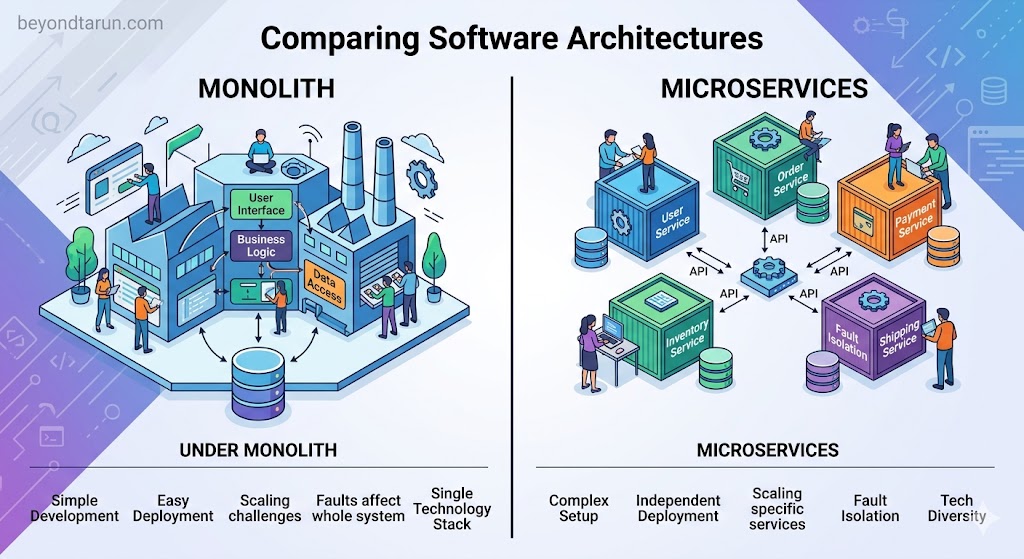
Deciding between a Monolithic architecture and Microservices is one of the most critical steps in a software journey. Think of it like choosing between an all-in-one Swiss Army knife and a toolbox full of specialized, high-end tools. Both have their place, but using the wrong one for the job can lead to major headaches down the road.
1. What is a Monolith?
A Monolith is a single-tiered software application in which the user interface and data access code are combined into a single program from a single platform. In simple terms, everything is bundled together: the database logic, the user handling, and the payment processing are all part of one big codebase.
The Python Example: A Monolithic Flask App
In a monolith, your code for different features lives in the same project.
from flask import Flask, jsonify

app = Flask(__name__)

# Feature 1: User Management
@app.route('/users')
def get_users():
    return jsonify({"message": "Fetching all users..."})

# Feature 2: Order Processing
@app.route('/orders')
def get_orders():
    return jsonify({"message": "Fetching all orders..."})

# Feature 3: Payment Gateway
@app.route('/payments')
def process_payment():
    return jsonify({"message": "Processing payment..."})

if __name__ == '__main__':
    app.run(port=5000)
Pros of Monoliths
- Simple to Develop: You start coding immediately without worrying about network connections between services.
- Easy Deployment: You only have one file or folder to upload to your server.
- Performance: Since everything is in the same memory space, communication between functions is instant.
Cons of Monoliths
- The “Jenga” Effect: If one small part of the code breaks (like a bug in the payment logic), the entire website goes down.
- Slow Scaling: If your “Orders” section gets a lot of traffic, you have to duplicate the entire app to scale, which wastes resources.
2. What are Microservices?
Microservices break that big “Swiss Army knife” into separate, independent services. Each service handles one specific job (like “Payments” or “Users”) and communicates with others over a network, usually via APIs.
The Python Example: Independent Services
In this world, the User service and Order service are completely separate programs, potentially running on different servers.
Service A: User Service (Running on Port 5001)
Python
from flask import Flask, jsonify

app = Flask(__name__)

@app.route('/users')
def get_users():
    return jsonify({"status": "Active", "user": "Tarun"})

if __name__ == '__main__':
    app.run(port=5001)
Service B: Order Service (Running on Port 5002)
Python
import requests
from flask import Flask, jsonify

app = Flask(__name__)

@app.route('/order-details')
def order_details():
    # Microservices talk to each other via HTTP
    user_info = requests.get("http://localhost:5001/users").json()
    return jsonify({
        "order_id": 101,
        "ordered_by": user_info['user']
    })

if __name__ == '__main__':
    app.run(port=5002)
Pros of Microservices
- Fault Isolation: If the “Order” service crashes, users can still log in and browse their profiles because the “User” service is still running.
- Tech Diversity: You can write your User service in Python and your high-performance Payment service in Go or Rust.
- Scalability: You can add more power specifically to the service that needs it.
Cons of Microservices
- Complexity: Managing 20 different services, 20 different databases, and the network between them is a massive task.
- Data Consistency: It’s harder to ensure that data is perfectly synced across different databases.
3. Which One Should You Choose?
| Feature | Monolith | Microservices |
| Team Size | Small teams (1–5 people) | Large engineering orgs |
| Startup Speed | Very Fast | Slower (requires setup) |
| Debugging | Easy (follow the stack trace) | Hard (logs are spread out) |
| Deployment | All-or-nothing | Independent updates |
The Verdict
Most successful companies including LinkedIn, Netflix, and Amazon—started as Monoliths.
Pro Tip: Don’t start with microservices just because they are “trendy.” If you are building a new MVP (Minimum Viable Product), stick to a monolith. It allows you to move fast and change your business logic quickly. Once your app grows so large that your team is constantly stepping on each other’s toes, that is the time to start carving out microservices.
Conclusion
Monoliths are about simplicity and speed, while Microservices are about scale and resilience. Understand your project’s needs before you commit to an architecture. If you’re building a simple blog or a small tool, keep it monolithic. If you’re building the next global e-commerce giant, start thinking about those independent services!
Check more articles on Computer Science
Leave a Reply