
How a chairmanship written off after two failed consensus statements produced a 140-paragraph declaration, a renewed Security Council push, a Kashmir terror condemnation with no caveats, and a claim to global economic leadership.
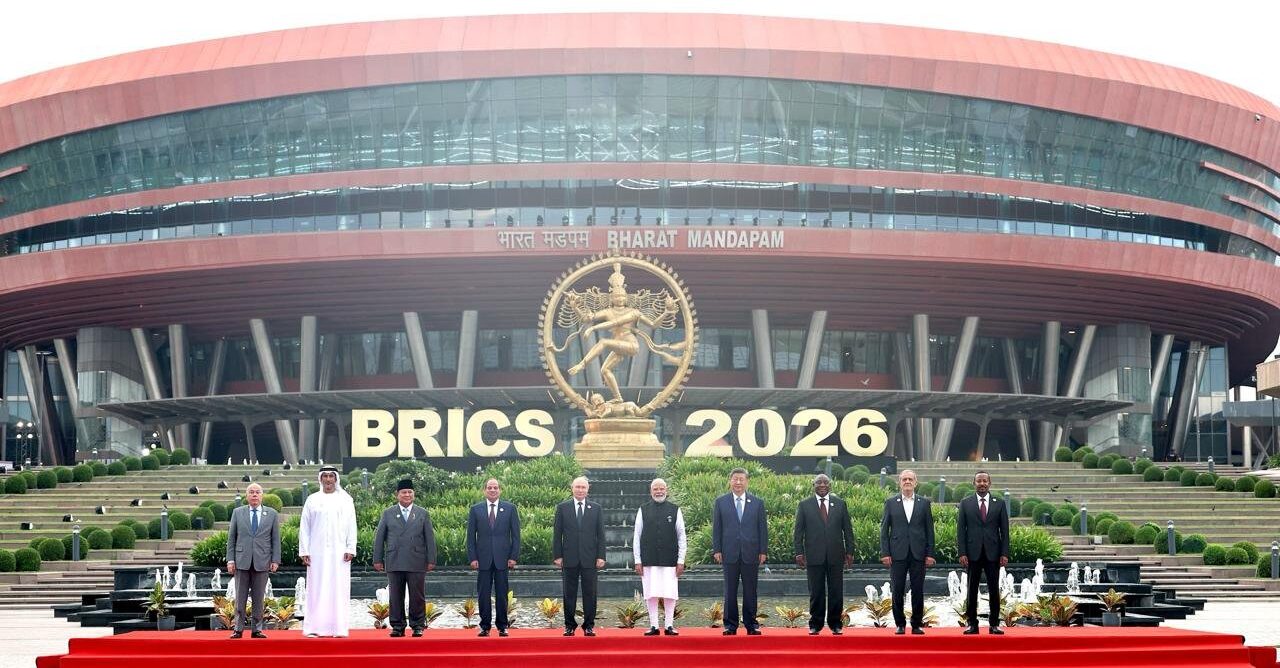
For most of 2026, the smart money on BRICS was that India’s chairmanship would end the way the year had gone: in fragments. In February, the summit closed without a joint statement after Iran and the UAE split over the strikes that had just hit Iranian territory. In May, the foreign ministers met in New Delhi and could not agree on a consensus outcome document either, again over the war in West Asia and over UAE objections to the bloc’s language on Palestine. By midyear, the working assumption inside most foreign ministries watching BRICS was that the New Delhi summit in September would produce, at best, a chair’s statement standing in for the group’s actual voice – the same face-saving workaround India itself had used in February.
That is not what happened. On September 12, BRICS leaders adopted the New Delhi Declaration: 140 numbered paragraphs, unanimous, covering everything from Gaza to Security Council reform to tuberculosis research. Two days earlier, the bloc’s finance ministers and central bank governors had already signed off on their own joint statement in Mumbai. A separate factsheet lists more than 400 meetings across thirty Indian cities and dozens of concrete deliverables. Whatever else can be said about BRICS this year, India did not simply avoid a second embarrassment. It reversed one, and it used the document to bank several diplomatic outcomes that will outlast this year’s chairship.
The diplomatic win: how consensus came back
The scale of that reversal is easy to understate because a joint declaration reads, by design, as though disagreement never happened. It did. Iran and the UAE remain on opposite sides of the same regional war that broke the February summit. The declaration’s language on West Asia – paragraphs 28 through 36 – is dense with the fingerprints of that argument: calls for “maximum restraint,” concern over “deliberate attacks on civilian infrastructure and peaceful nuclear facilities,” support for the Lebanon ceasefire, condemnation of attacks on UN peacekeepers, and a carefully hedged formulation on Gaza that welcomes the October 2025 ceasefire while expressing “deep concern on the continued violence” since. None of that is accidental phrasing. It is the visible seam where India, as chair, had to find words that Tehran, Abu Dhabi, and everyone else could sign without conceding the argument to the other side.
Getting there took the plainest tool available to a rotating chair: attrition and personal diplomacy rather than institutional leverage, since BRICS has no voting mechanism and no way to compel a holdout. India spent the second half of 2026 doing exactly that – Iranian President Pezeshkian’s visit to brief Indian leaders directly on the West Asia conflict, parallel channels to Abu Dhabi, and a chair’s summary process patient enough to survive the May collapse without abandoning the September deadline. The declaration’s own paragraph 2 gestures at the method: it commits BRICS to cooperation “in the spirit of extensive consultation, joint contribution and shared benefits” – diplomatic boilerplate, but boilerplate that had visibly failed twice already this year before it held on the third attempt.
A bloc that could not agree on a single sentence in February and May producing a 140-paragraph unanimous text in September is not a footnote to the summit. For a chair with no coercive tools, it is close to the whole story.
Security Council reform: the paragraph India has waited years for
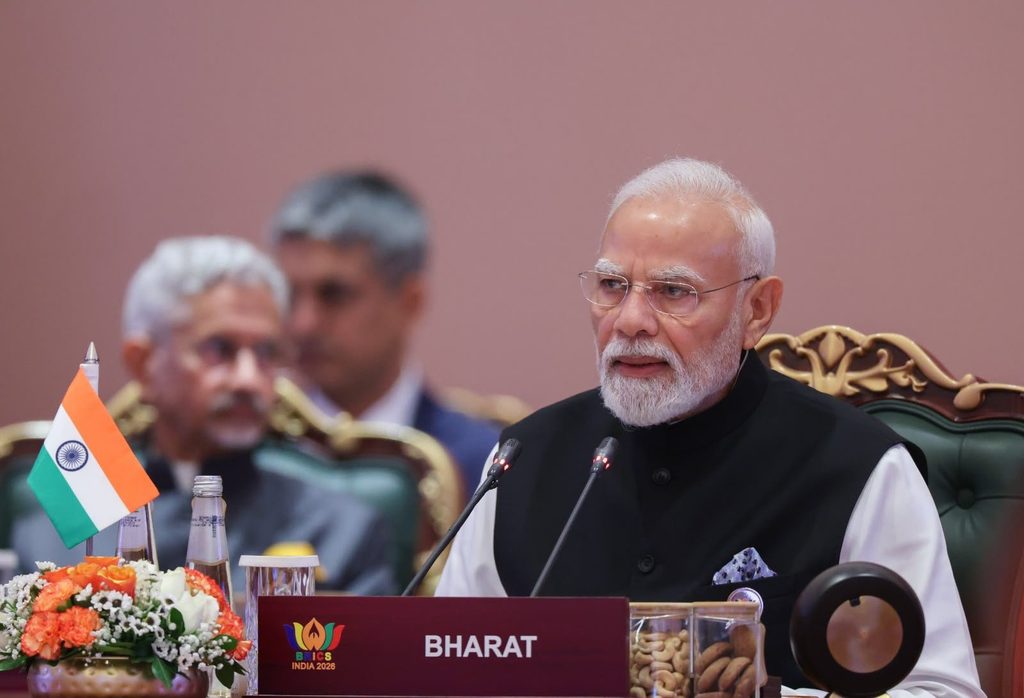
The clause that deserves more attention than it has received sits early in the declaration, in the section on reforming global governance. Paragraph 13 explicitly recalls the 2022 Beijing and 2023 Johannesburg-II Leaders’ Declarations and states that China and Russia, as permanent Security Council members, “reiterate their support to the aspirations of Brazil and India to play a greater role in the UN, including its Security Council.” This is not a throwaway line. It is one of the very few instances in which Beijing puts its name, in a signed multilateral text, next to explicit support for an expanded Indian seat at the table that matters most in international security – support China has been notably reluctant to spell out in bilateral settings, where it tends toward vaguer language about “understanding India’s aspirations” rather than endorsing them outright.
The surrounding paragraphs build the case with more than just India’s name attached. Paragraph 8 calls for “greater and more meaningful participation and representation” of developing countries in global decision-making, and paragraph 9 makes an unusually pointed observation for a consensus document: that no woman has ever been elected UN Secretary-General, and that only two nationals from Africa and Asia combined, and one from Latin America and the Caribbean, have ever held the post – a statistic timed deliberately to land during the ongoing selection process for the next Secretary-General. Paragraph 10 frames Security Council reform explicitly as a multipolarity issue, arguing that the “amplified voice of the Global South” is the point of the exercise, not an incidental benefit. None of this forces a Security Council vote. What it does is keep India’s candidacy inside the bloc’s standing text, year after year, at a moment when the composition of the Council is genuinely being discussed more seriously in UN corridors than it has been in a decade.
The declaration pairs this with a defence of the G20’s existing architecture that has its own India angle. Paragraph 116 commits BRICS to “preserve the legacy” of the consecutive BRICS presidencies of the G20 – Indonesia, India, Brazil, and South Africa across 2022 to 2025 – and to defend South Africa’s G20 founding membership against “arbitrary revision,” a clear if unstated reference to pressure Pretoria has faced this year. For India specifically, cementing its own 2023 G20 presidency into the bloc’s official memory, alongside the African Union’s accession to the G20 that India brokered that year, is a second, quieter piece of the same project: writing India’s recent record of successful multilateral chairmanships into a document eleven other governments have now co-signed.
Terror: the paragraph India needed
Buried in the declaration’s security section is the line Indian diplomats will have worked hardest for. Paragraph 40 names the April 2025 terrorist attack in Jammu and Kashmir directly – twenty-six people killed – and condemns it “in the strongest terms.” It goes further than naming the incident: it states that terrorism “should not be associated with any religion, nationality, civilization or ethnic group,” calls for “zero tolerance for terrorism” and rejection of “double standards in countering terrorism,” and commits BRICS members to holding perpetrators and their backers accountable under national and international law.
That combination of clauses matters more than it looks. India has spent years in multilateral forums pushing back against language that implicitly treats cross-border terrorism as a bilateral India-Pakistan dispute rather than a security threat the wider grouping should name and condemn as such. Getting Russia and China – the latter Pakistan’s closest strategic partner and a state with its own reasons to be cautious about setting precedents on naming terrorism by geography – to sign on to explicit condemnation of an attack on Indian soil, without the language being diluted into generic anti-terrorism boilerplate, is a genuine negotiating result. The “no religion, no double standards” formulation is India’s preferred framing for exactly this reason: it forecloses the argument, common in other forums, that some terrorism is more explicable or more excusable than others depending on its stated cause.
The declaration pairs that paragraph with real institutional machinery rather than leaving it as rhetoric alone: the BRICS Counter-Terrorism Working Group and its five subgroups, a push to finalise the long-stalled UN Comprehensive Convention on International Terrorism, and a separate commitment to countering youth radicalisation. Paragraph 41 goes further still, flagging the need to counter extremism and radicalisation specifically “among the younger generations” – an India-favoured framing that speaks to its own domestic counter-radicalisation concerns as much as to any single member’s. None of this changes the operating reality on India’s western border. But as a diplomatic marker – a signed, dated statement by Russia, China, Iran, and seven other governments naming an attack on Indian territory in unambiguous terms – it is a result India will use again, including in forums where China has historically been far less willing to co-sign such language.
West Asia, Sudan, and the balancing act
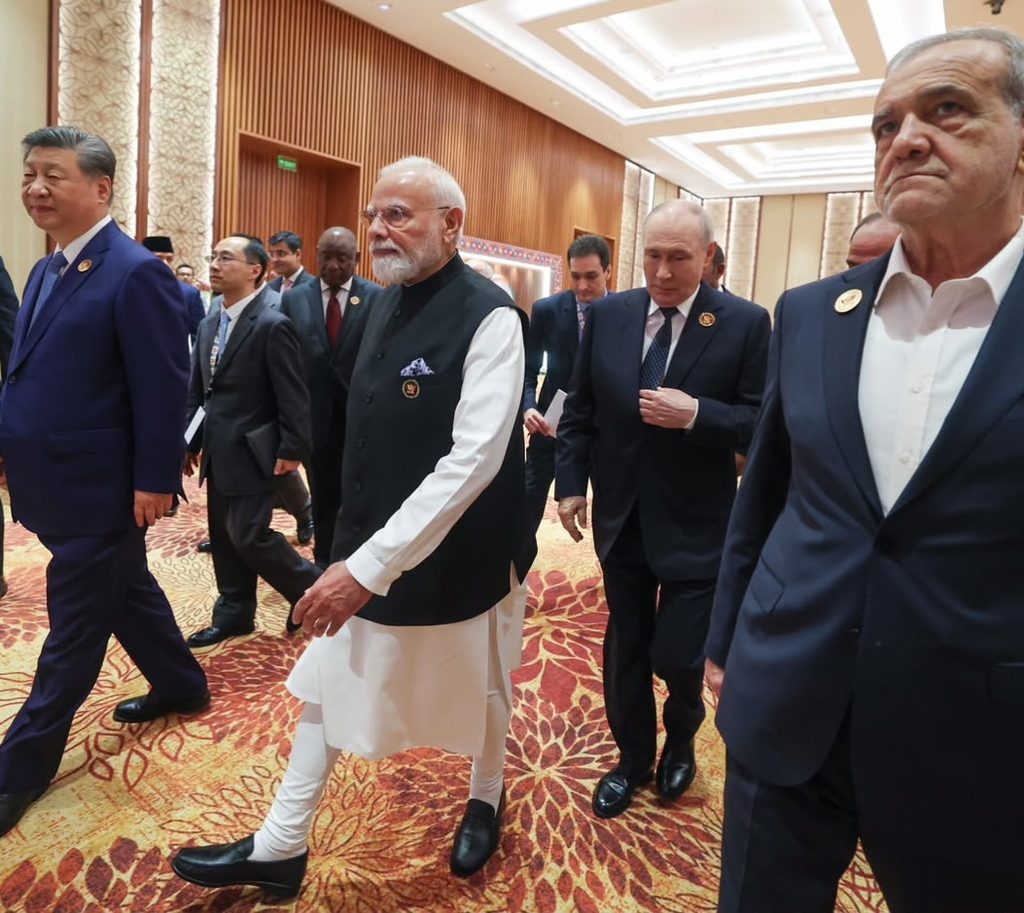
The declaration’s regional-conflict paragraphs are worth reading as a set, because together they show a chair trying to hold every member’s red line at once rather than pick a side. On Gaza, paragraphs 30 through 34 take note of UN Security Council Resolution 2803, call for the ceasefire and humanitarian access to be maintained, oppose forced displacement of Palestinians, and reaffirm support for Palestinian UN membership and a two-state solution along 1967 lines with East Jerusalem as its capital – language the UAE had reportedly sought to soften earlier in the year, restored here in full. On Lebanon, the bloc welcomes the ceasefire, condemns its violations, and explicitly extends condolences for the loss of Indonesian and other peacekeepers serving under UNIFIL, a detail that ties Indonesia’s own new BRICS membership directly into the text. On Sudan, paragraph 37 expresses grave concern over the humanitarian crisis and invokes the principle of “African solutions to African problems” – deferring, deliberately, to African Union leadership rather than asserting a BRICS role. On Syria, the declaration backs a Syrian-led, UN-facilitated transition free of foreign interference and calls for the withdrawal of occupying forces, without naming which forces.
Paragraph 29’s language on “deliberate attacks on civilian infrastructure and peaceful nuclear facilities under full safeguards of the International Atomic Energy Agency” is the clearest trace of the Iran-UAE argument that broke the February summit – it is the kind of sentence that could only have been reached by two sides each getting a version of the point they wanted without naming the other as the culprit. For India, holding all of this together while also advancing its own bilateral interests with Iran, the Gulf states, and Israel simultaneously is itself a demonstration of exactly the kind of “multi-alignment” foreign policy New Delhi has spent a decade building. The declaration does not resolve any of these conflicts. It does show that India can chair a room containing all of their protagonists without the room breaking apart on its watch – a capability the February and May failures had called into serious doubt.
Finance: quota reform, GIFT City, and the payments question
The Mumbai finance ministers’ statement and the leaders’ declaration together sketch where BRICS actually moves the needle economically, and where it still does not. On IMF governance, the bloc reiterates the “Rio de Janeiro Vision” for quota reform, pushes for the 16th General Review of Quotas to take effect “with no further delay,” and calls for a 17th review that shifts voting share toward emerging economies without penalising the poorest members. This is a long-running BRICS demand, not a new one, but the language is sharper than in previous years, and it lands at a moment when quota realignment talks have genuinely stalled inside the Fund. A louder, more unified BRICS voice on this – India, China, and Russia all hold Security Council-adjacent leverage even if they lack the IMF votes to force the issue alone – raises the cost of continued delay for Washington and the Fund’s other major shareholders.
The more India-specific win sits in the financial plumbing paragraphs. India’s proposal to host a BRICS Risk Lab at the GIFT City International Financial Services Centre in Gujarat received explicit member interest in both the Mumbai statement and the leaders’ declaration – a concrete step toward positioning GIFT City as a hub for BRICS reinsurance and financial-risk cooperation rather than just a domestic offshore centre. Alongside it, the BRICS Payment Task Force continues exploring cross-border payment interoperability and local-currency settlement, though the declaration is notably careful to say there is “no one-size-fits-all approach” – diplomatic language for the fact that a common BRICS currency or unified payment rail remains politically unresolved. The New Investment Platform, discussed for years, stays at the study-group stage. Where BRICS finance track delivers concretely is narrower and more technical: a Contingent Reserve Arrangement being made more responsive, a New Development Bank knowledge portal launched under India’s chairship, a tax cooperation network, and new working groups on transfer pricing – real, if unglamorous, institution-building rather than the headline-grabbing dedollarisation architecture the bloc talked about in 2023.
Two smaller finance-track items are worth noting for what they signal about India’s role specifically. The BRICS Central Bank Hub for Capacity Building, and the proposed BRICS Women in Tax Network and Young Tax Professionals programme, were both advanced substantially under India’s chairship – evidence that New Delhi used its year in the chair to seed institutions it can continue shaping even after the gavel passes to China in 2027. The Contingent Reserve Arrangement’s Ninth Test Run, and the onboarding talks for new members interested in joining the CRA, are similarly incremental, but they are the kind of plumbing work that determines whether the BRICS financial safety net is credible in an actual crisis rather than merely on paper.
Economy: reform rhetoric meets a defensive trade posture
On the wider economic architecture, the declaration reads less like a blueprint and more like a coordinated objection. BRICS “condemns the imposition of unilateral coercive measures,” opposes carbon border adjustment mechanisms as disguised protectionism, and repeatedly criticises “unilateral tariff and non-tariff measures” that are “inconsistent with WTO rules” – language clearly, if not explicitly, aimed at the tariff regime Washington has pursued through 2026, including the sanctions pressure applied over Iran-linked trade that shadowed the bloc’s own internal disputes this year. The Bretton Woods institutions get the now-standard call for reform: a bigger, more representative World Bank shareholding structure, WTO dispute-settlement restoration, and support for Ethiopia’s and Iran’s WTO accession bids. Paragraph 27, on Cuba, is a smaller but telling addition – a reiterated call to end the US economic blockade, a position India has historically supported at the UN General Assembly and reaffirms here without controversy among the wider membership.
What the declaration does not do is offer BRICS as an alternative economic architecture in any operational sense. The BRICS Grain Exchange remains at the discussion stage. The Strategy for BRICS Economic Partnership 2030, which India is credited with advancing to conclusion this year, is a framework document rather than a binding commitment. The G20 language is telling in this respect: BRICS reaffirms the G20 as “the premier global forum for international economic cooperation” and commits to defending South Africa’s G20 membership against any “arbitrary revision” – a grouping big enough to rival the G7 in GDP terms is still, by its own declared preference, working inside the existing system rather than building a rival one.
Cooperation: breadth as the actual deliverable, and a clutch of smaller wins
If there is a single organising fact behind the New Delhi summit, it is volume. The chairship factsheet lists outcomes across four pillars – Resilience, Innovation, Cooperation, Sustainability – spanning agriculture, health, energy, customs, education, sport, and culture, the product of more than 400 meetings in thirty cities over the year. Most of these are modest by design: a working group here, a compendium of best practices there, a non-binding guiding principle on smart grids or traditional medicine. Individually, none of them reorders the global order. Collectively, they are the evidence India will point to that its chairship generated activity and follow-through rather than a single summit photograph.
A handful of smaller items carry outsized diplomatic weight for India specifically. Paragraph 88 welcomes India’s own chairship of the Kimberley Process – the global rough-diamond certification scheme – in 2026, placing India at the centre of a separate multilateral track that intersects with its own gem and jewellery export industry. Paragraph 105 welcomes Ethiopia’s and Indonesia’s candidatures for expanded seats on the ICAO Council, a minor aviation-governance matter that nonetheless signals BRICS coordinating votes inside a UN specialised agency. The declaration also formally thanks India for hosting the summit and “extends full support” to China for the 2027 chairship – paragraph 139 and 140 read almost as a formal handover ceremony, and the fact that China’s chairship is endorsed unanimously, in the same document that also reaffirms Chinese support for India’s Security Council aspirations, suggests the Beijing-New Delhi relationship inside BRICS specifically has been managed with unusual care this year even as the border dispute between the two remains unresolved.
This is also where the declaration’s real character shows most clearly. BRICS functions less as a bloc that decides and more as a bloc that convenes – ministries, regulators, customs officers, and central bankers across eleven very different states, meeting under a shared calendar and a shared chair, producing frameworks that each member can adopt, ignore, or adapt to national circumstances almost entirely at will. That is a lower bar than binding treaty cooperation. It is also, this year, a bar BRICS cleared far more often than sceptics – this publication included, in an earlier piece on the bloc’s internal fault lines – expected.
What India takes home
- A first Xi Jinping visit to India since 2019, and a Modi-Xi-Putin trilateral moment staged entirely on Indian soil, at a chairmanship India could easily have lost control of after February and May.
- A signed, unanimous reaffirmation – paragraph 13 – of Chinese and Russian support for India’s Security Council aspirations, one of the few multilateral texts in which Beijing puts that support in writing rather than leaving it as verbal reassurance.
- An explicit, unhedged condemnation of the April 2025 Jammu and Kashmir terror attack, with “no religion, no double standards” language that denies space for the attack to be reframed as a bilateral or regional matter.
- India’s own G20 presidency and the African Union’s G20 accession written into a standing BRICS text as part of the bloc’s defended legacy, alongside support for South Africa’s G20 membership against “arbitrary revision.”
- A concrete institutional foothold for GIFT City as a candidate BRICS financial-risk hub, advancing a domestic policy priority through a multilateral platform.
- India’s chairship of the Kimberley Process folded into the same year as its BRICS chairship, reinforcing New Delhi’s position across two overlapping multilateral tracks at once.
- A chairship legacy of volume and follow-through – the 400-meeting, four-pillar record – that India can set against Brazil’s and South Africa’s more thematically narrower recent chairships.
- The diplomatic credibility of having turned two consecutive 2026 consensus failures into a unanimous 140-paragraph declaration, a result India can now point to in every future forum where its convening skill is in question.
None of this resolves what this publication has argued elsewhere: BRICS remains a grouping whose members disagree with each other about as much as they disagree with the West they claim to be balancing against. The Iran-UAE rift that broke two 2026 meetings is papered over in New Delhi, not settled. The India-China border remains exactly where it was. Saudi Arabia’s membership is still more gesture than fact. Chinese support for an Indian Security Council seat is a standing line in a non-binding declaration, not a vote Beijing has any near-term intention of enabling. But papering over a rift with a document every member is willing to sign, and getting your own strategic priorities – the Council seat, the Kashmir condemnation, GIFT City, the G20 legacy – embedded in that same document, is itself a diplomatic skill. This week, it was India’s. For a chairmanship that spent most of the year being written off, the New Delhi Declaration is a genuine, and somewhat unexpected, result.
Leave a Reply