
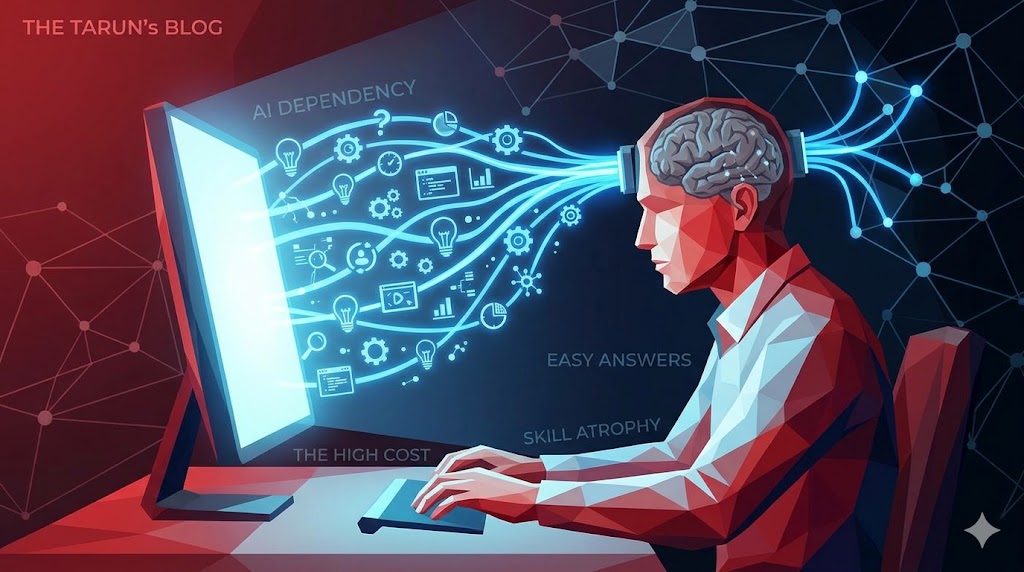
“In a hurry? The shift to AI dependency is boosting output but eroding deep-thinking skills essential for leadership.”
In recent time, many large tech firms across India have begun actively pushing employees to adopt AI tools such as Microsoft Copilot and other intelligent assistants. What started as optional productivity support is quickly becoming a workplace expectation. On the surface, this shift delivers clear benefits-higher efficiency, faster output, increased client satisfaction, and ultimately, greater revenue for companies.
However, beneath this surge in productivity lies a growing concern. While organizations gain speed and scale, employees may be paying a hidden price: a gradual decline in independent thinking and intellectual depth. This rising AI dependency is not just changing how we work it is reshaping how we think.
The Rise of AI Dependency
Artificial intelligence tools have revolutionized productivity. Tasks that once required hours of research, brainstorming, and execution can now be completed in minutes. Whether it’s writing emails, solving complex problems, or analyzing data, AI offers quick and efficient solutions.
This convenience has led to a shift in how we approach work. Instead of thinking through problems step-by-step, many people now jump directly to AI for answers. Over time, this creates a pattern of dependency where the brain begins to rely on external systems rather than internal reasoning.
How AI Dependency Affects the Brain
1. Decline in Critical Thinking Skills
One of the most significant effects of AI dependency is the gradual decline in critical thinking. Critical thinking involves analyzing, questioning, and evaluating information before arriving at a conclusion. When AI provides ready-made answers, this process is often skipped.
Instead of asking “Why does this work?” or “Is this correct?”, users tend to accept AI-generated responses at face value. Over time, this reduces the brain’s ability to question and analyze deeply.
2. Reduced Problem-Solving Ability
Problem-solving is like a mental workout. The more you engage in it, the stronger your cognitive abilities become. However, AI dependency removes the need for struggle the very element that strengthens understanding.
When individuals rely on AI to solve problems instantly:
- They miss out on learning through trial and error
- They fail to develop resilience in tackling complex challenges
- Their ability to approach unfamiliar problems weakens
This can become a serious issue in real-world situations where AI assistance may not be available.
3. Shortened Attention Span
AI tools are designed for speed and efficiency. While this is beneficial, it also trains the brain to expect instant results. As a result, people may find it harder to focus on tasks that require sustained attention.
Long-form reading, deep analysis, and creative thinking demand patience. But with AI delivering quick answers, the brain becomes less tolerant of slow, effort-intensive tasks.
4. Memory and Retention Issues
When we rely on AI to store and retrieve information, our brain reduces its effort to remember things. This is similar to how people rely on calculators for basic math or smartphones for contact numbers.
Over time, this leads to:
- Reduced memory retention
- Lower recall ability
- Dependence on external systems for basic knowledge
While outsourcing memory isn’t entirely harmful, excessive reliance can weaken cognitive independence.
5. Illusion of Knowledge
AI dependency can create a false sense of intelligence. When users generate high-quality outputs using AI, they may feel they fully understand the topic even when they don’t.
This illusion becomes dangerous in situations like:
- Job interviews
- Academic evaluations
- Real-world problem-solving scenarios
If someone cannot explain or defend what they’ve produced, it highlights a gap between perceived knowledge and actual understanding.
Behavioral Changes Due to AI Dependency
1. Shift from Creator to Curator
People are increasingly becoming editors rather than creators. Instead of building ideas from scratch, they refine AI-generated content. While this improves efficiency, it reduces originality and creative thinking.
2. Decreased Confidence in Independent Thinking
Ironically, relying too much on AI can reduce self-confidence. Individuals may begin to doubt their own ideas and feel the need to “check with AI” before making decisions.
3. Avoidance of Mental Effort
The brain naturally seeks efficiency. When AI provides an easier path, people may avoid tasks that require deep thinking. This leads to intellectual laziness over time.
The Long-Term Risks of AI Dependency
If left unchecked, AI dependency can lead to several long-term consequences:
- Skill Atrophy: Core skills like writing, reasoning, and analysis may weaken
- Reduced Innovation: Creativity thrives on deep thinking, not shortcuts
- Workplace Vulnerability: Employees who cannot think independently may struggle in high-pressure or novel situations
- Over-Reliance on Technology: A system failure or lack of access could significantly impact productivity
How to Use AI Without Losing Your Mind’s Edge
AI is not the enemy. The problem lies in how it is used. The key is to build a balanced relationship where AI supports not replaces human thinking.
1. Practice the “Think First” Approach
Before using AI, attempt the task yourself. Even a rough attempt engages your brain and strengthens understanding.
2. Use AI for Enhancement, Not Replacement
Let AI refine your ideas, not generate them entirely. Treat it as a second opinion rather than the primary source.
3. Ask “Why” and “How”
Whenever you use AI, make sure you understand the logic behind the answer. If you can’t explain it, you haven’t truly learned it.
4. Engage in Deep Work
Set aside time for focused, distraction-free thinking. Activities like reading, writing, and problem-solving without AI help maintain cognitive strength.
5. Limit Overuse
Use AI selectively. Not every task needs automation. Sometimes, doing things manually is more beneficial for learning.
The Future: Humans and AI Together
AI dependency is not inherently negative it becomes a problem only when it replaces human thinking entirely. The future belongs to individuals who can combine the speed of AI with the depth of human intelligence.
Those who maintain strong cognitive skills while leveraging AI effectively will have a significant advantage. They will not just consume answers they will understand, question, and innovate.
Conclusion
AI dependency is reshaping the way we think, learn, and work. While it offers unmatched efficiency, it also poses risks to critical thinking, problem-solving, and cognitive independence.
The human mind is incredibly powerful, but like any muscle, it requires regular use to stay strong. By using AI mindfully and maintaining active engagement in thinking processes, we can ensure that technology enhances our intelligence rather than diminishing it.
In the end, the goal is not to reject AI but to remain smarter than the tools we use.
Leave a Reply